This page brings together completed research projects of the Department, as well as earlier research initiatives funded by the Research Committee of the National and Kapodistrian University of Athens. Select a section below to explore detailed information about each project.
The following section presents completed research projects carried out by the Department.

Research Programme on Improvisation Techniques for Mental Health Professionals
ACTitude develops an innovative methodology based on improvisation techniques (Improv), aiming to empower individuals experiencing mental health disorders in dealing with social rejection, verbal abuse and ridicule. The programme is designed for mental health professionals and combines tools from improvisational theatre with third-wave psychological therapies.
Through an experiential and participatory approach, the project applies Improv methodologies to strengthen communication, self-expression and self-protection skills. The ACTitude framework helps individuals recognise incidents of verbal violence, build self-confidence and respond effectively in real time, interrupting abusive behaviours.
At the same time, the project provides professionals working with the target group with a specialised and adaptable intervention framework that can be implemented in educational, therapeutic and community-based settings.
ACTitude is carried out by an interdisciplinary team of researchers, psychologists and artists specialising in improvisation and its applications for socially vulnerable groups, promoting inclusion, empowerment and respect for diversity.
Digital Platform for Mapping Book-Related Events in Greece
BOOKGEOGRAPHY is the first systematic digital platform dedicated to recording and mapping book-related events throughout Greece. Its aim is to provide timely information to the public, support the study of book culture and literary activity, and foster connections among authors, institutions, publishers and professionals in the field.

THALES Programme: "CHRYSALLIS" – Cultural Transfer and the Formation of "National Character" in Nineteenth-Century Greek Periodicals
The CHRYSALLIS research project examines the role of nineteenth-century Greek periodicals in shaping the national identity and the "national character" of the newly established Greek state. Through the study of ideological, literary and cultural currents, the project highlights how periodicals functioned as sites of cultural transfer, collective memory and the redefinition of the relationship between Hellenism and alterity.

Digital Arts Dialogue
DigiArts is a European project that combines the principles of Restorative Justice with the arts and digital tools in order to strengthen dialogue between young people and professionals working with youth. The project seeks to develop an innovative and effective methodology that promotes participation, communication and social inclusion through creative expression and the possibilities offered by digital environments.
DigiArts focuses on situations where dialogue has been interrupted and aims to develop meaningful and effective communication between young people and youth workers, enabling them to collaborate and support one another through innovative digital approaches. The project promotes a creative methodology for youth workers, encouraging social inclusion through artistic practice and digital engagement.
Drawing on the values of Restorative Justice in the Arts, DigiArts strengthens cooperation, dialogue and mutual understanding among young people across Europe, while fostering active participation, creativity and intercultural exchange.
Gender Equality, Social Skills and Values Education through Drama-Based Training
The GENDER DRAMA-ID project aims to empower persons with disabilities and promote gender equality through an innovative drama-based educational approach (Drama Based Training – DBT). Within the framework of the project, an accessible and inclusive DBT methodology is being developed, adapted to the learning needs and challenges of participants. The approach is grounded in experiential learning through theatre and drama, creating a safe and creative environment for expression, collaboration and personal growth.
Through participatory activities and theatre techniques, the project strengthens the development of social skills, self-confidence and the active participation of persons with disabilities. At the same time, it promotes values such as equality, respect, acceptance of diversity and social inclusion.
GENDER DRAMA-ID aspires to establish an innovative methodology that supports the equal participation of all individuals in social and cultural life.
Drama-based training functions as a tool for experiential learning and the promotion of social awareness.
The participatory nature of drama-based activities strengthens communication, empathy and collaboration.
LYRIQAS – Creative Europe
Research and Artistic Project for the Contemporary Interpretation of Europe’s Shared Cultural Heritage
LYRIQAS is a research and artistic project funded by the European Union, exploring Europe’s shared cultural heritage through contemporary forms of music, theatre and cinema. It brings together emerging artists from Athens, Galicia and Braga with the aim of co-creating new works inspired by Europe’s enduring cultural traditions. Through artist exchange and residency programmes, as well as an interdisciplinary arts festival, the project promotes collaboration, cultural exchange and engagement with young audiences.


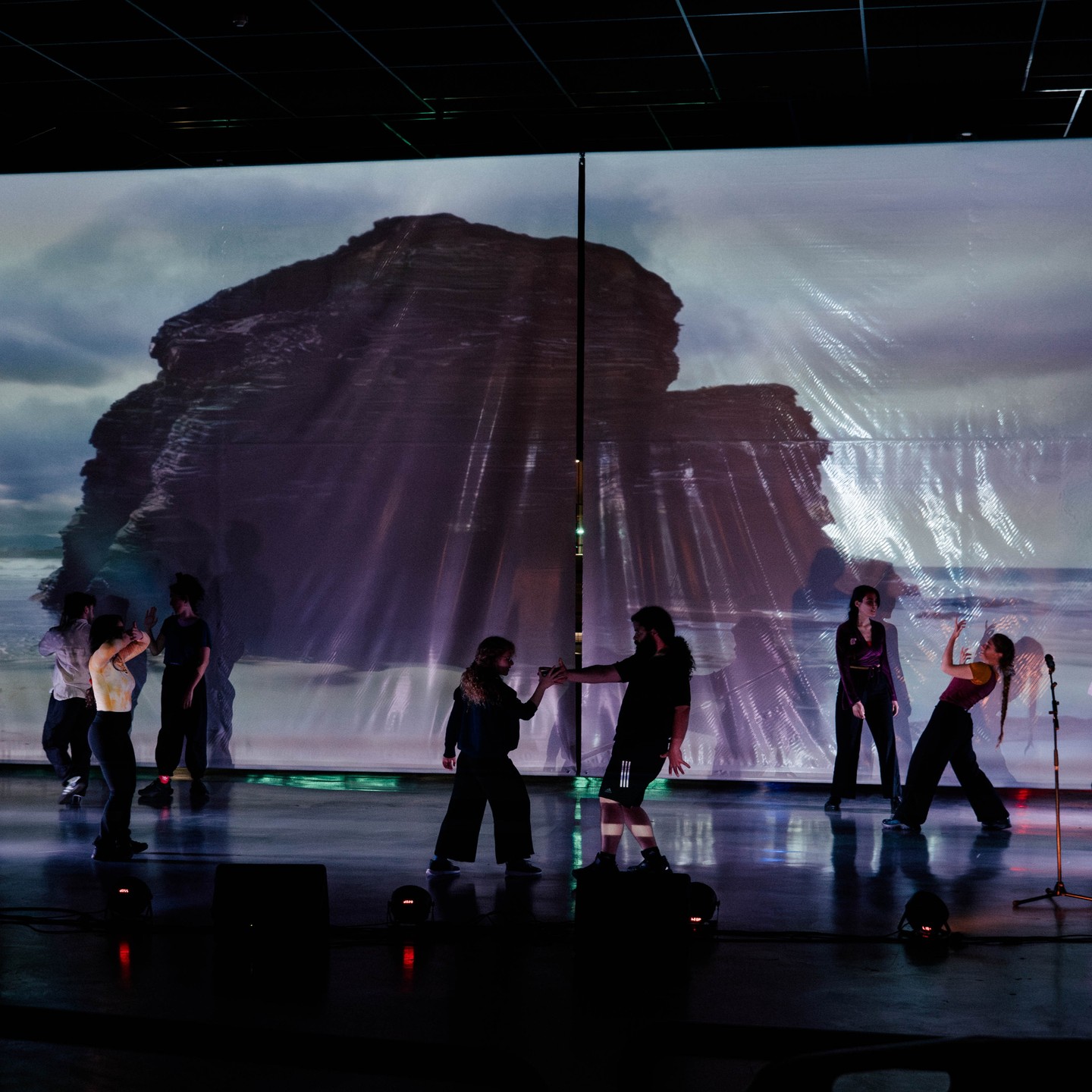

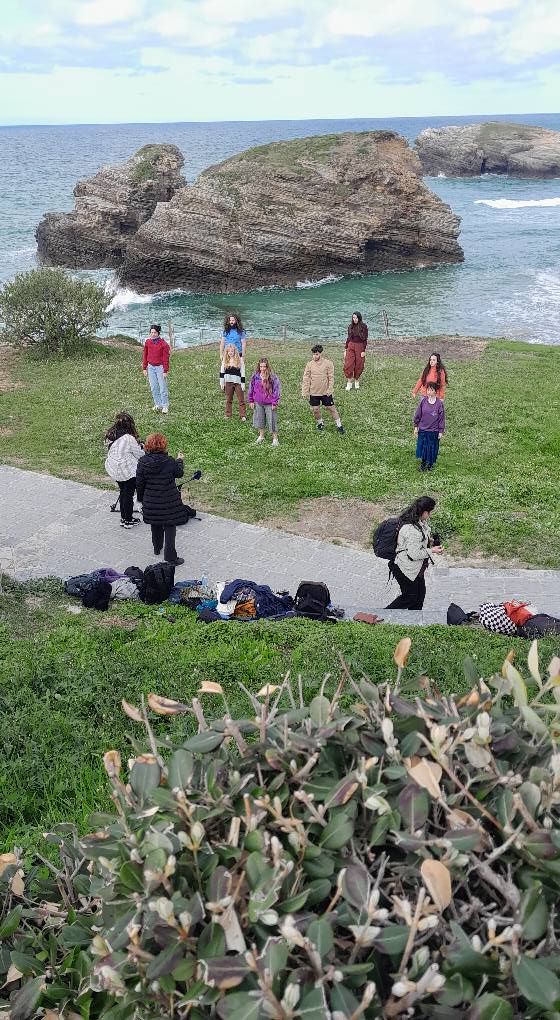
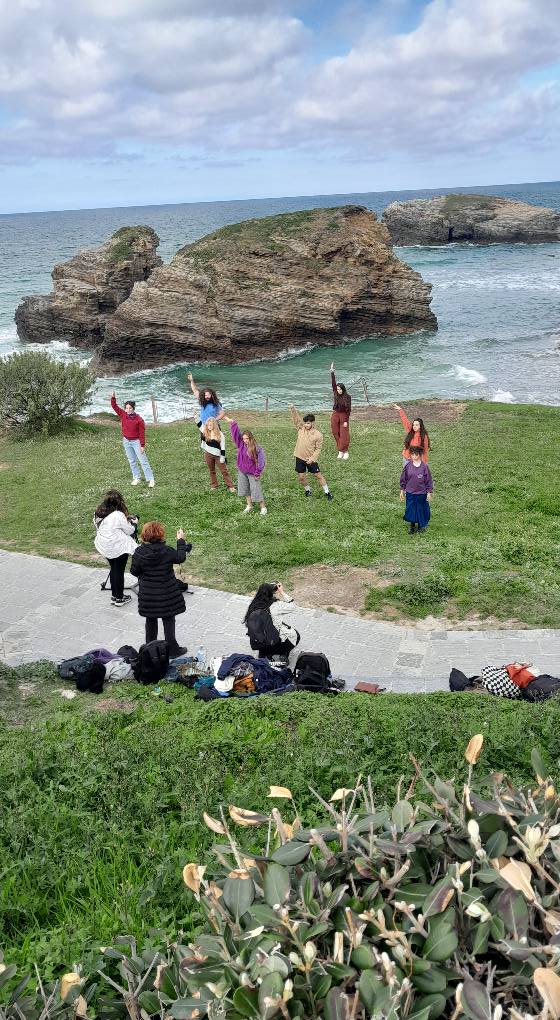

Athens / Counter-Monument: A Gathering of Political Bodies
The Department of Theatre Studies organised and participated in the Greek Student Exhibition at PQ23, approaching the historic centre of Athens not merely as a monumental landscape but as a living, polyphonic and performative field.
The overall proposal presented the city as a “living performative archive” through a series of site-specific interventions connecting public space with issues of identity, gender, desire, gentrification, homelessness, migration and refugee experience, as well as contemporary forms of protest.
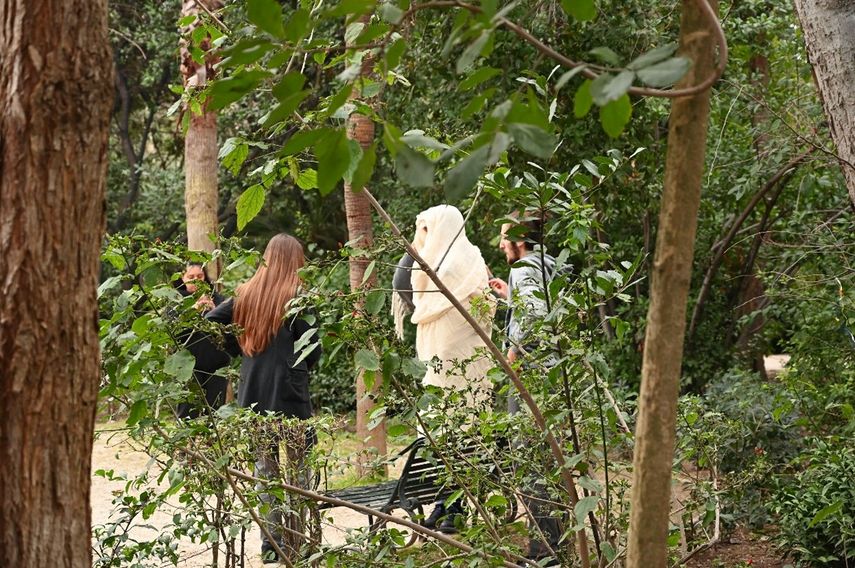
A performance based on images and objects from the urban fabric of Athens, reconstructing the city as “our home”. Presented in the National Garden, the work highlighted the search for nature, balance and tranquillity within contemporary urban life.
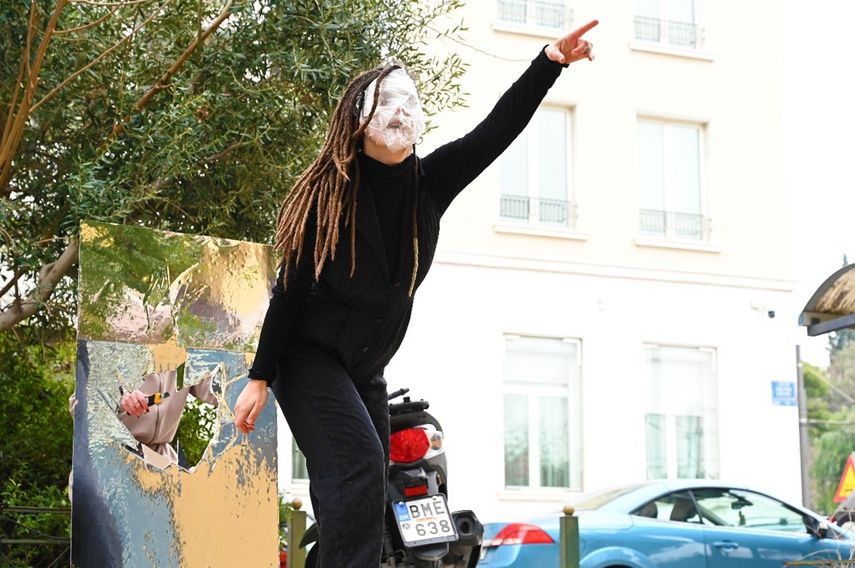
A public intervention in the National Garden where a participant is symbolically “buried” in gauze while a ritual of mourning unfolds before spectators and cameras, commenting on the performativity of grief and its public exposure.
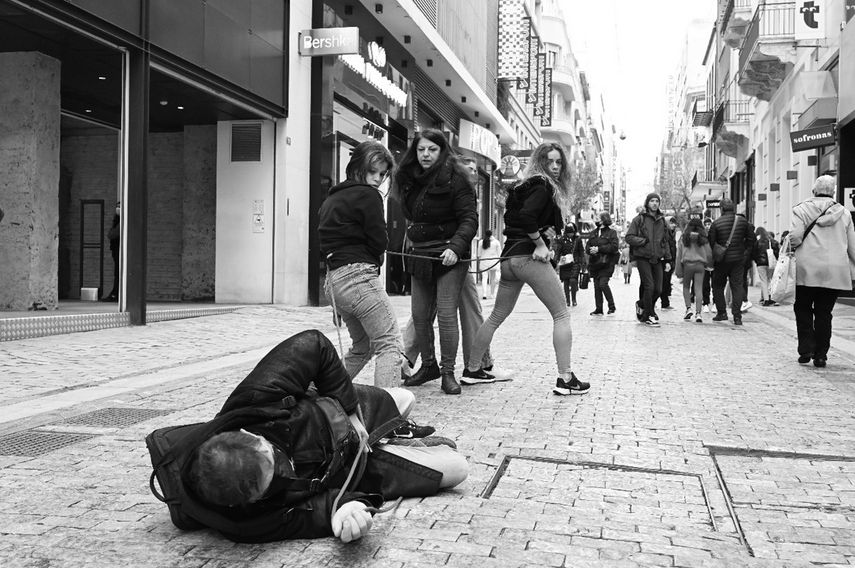
Drawing inspiration from the “Monument to the Unknown Artist”, this performance transforms an urban trace into a political reflection on existence, art, love and the need of every body to claim space for expression and visibility.

A public intervention on Ermou Street in which five performers, tied together with rope, attempt to move through a space dominated by images of consumption, exploring the external inscriptions of restriction imposed upon the political and social subject.
Unpublished Translations of Ancient Drama: Detection – Documentation – Collection – Evaluation
The PLUTUS 21 research project aims to identify, document, collect and digitise unpublished translations of ancient drama. This material constitutes a valuable yet largely unexplored source for the study of the linguistic, translational, theatrical and cultural reception of ancient drama in modern and contemporary Greece.
In its first phase, the project focuses on the search, identification, documentation, collection and, where possible, transcription or digitisation of unpublished theatrical translations. These include unpublished works, partially published translations, translations published non-independently in anthologies and journals, as well as dormant or lost material.
These “hidden” translations, many of which are associated with significant theatrical productions and originate from distinguished writers and artists, constitute valuable archival material for investigating the linguistic, translational, theatrical and cultural reception of ancient drama in modern and contemporary Greece.
In a second phase, the translations are systematically documented through detailed records including title, source text, classification, translator identity, source or location of discovery, performances in which they were used, paratextual elements, linguistic and formal characteristics, as well as interventions made to the text (cuts, additions, rearrangements and other modifications).
The collected archival material will be made available to students, early-career researchers, academics, drama school instructors, artists and the wider public through the archive hosted by the Laboratory of Ancient Drama and Theatre Research of the Department of Theatre Studies, National and Kapodistrian University of Athens.
Research Programme on Greek Theatre Bibliography
The project aimed to identify, document, collect and evaluate scholarly sources, books, studies and journal articles written in Greek concerning Modern Greek and World Theatre, as well as unpublished doctoral dissertations related to Greek Theatre Studies.
The bibliography was organised into five major categories: general history and bibliography of Modern Greek theatre, chronological classification of Modern Greek theatre, thematic classification, general history of foreign theatre in the Greek language, and studies on foreign theatre.
This comprehensive bibliography constitutes an important research tool for students, doctoral candidates, theatre scholars and researchers in Modern Greek Studies. For the first time, it brings together a substantial body of material that is difficult to locate either through existing bibliographies or through automated library catalogues available online.
Performance Documentation and Archiving of Ancient Greek Drama Productions in Greece – Digitisation of Related Audiovisual Material
The project focused on the development of a comprehensive database of Ancient Greek drama productions presented in Greece, following internationally recognised standards for documentation and digital archiving. Its primary objective was the systematic electronic recording and preservation of performance-related material.
Core activities included the design and development of the database, the creation of interoperability tools for communication with other databases, the digitisation of archival and audiovisual material, the integration of productions staged between 1992 and 2002, and the verification and documentation of previously recorded entries.
Through systematic documentation and digitisation, the project established the foundations for a deeper understanding of the stage reception of Ancient Greek drama in Greece and internationally. It strengthened interdisciplinary collaboration and supported the use of interactive audiovisual technologies in both research and teaching.
"SEMELE" Ancient Theatre Database
The SEMELE database was designed for the systematic recording, organisation and management of information relating to Ancient Theatre on archaeological, literary and bibliographical levels.
The project approaches Ancient Theatre as a complex cultural phenomenon encompassing architectural expression, theatrical practice, literary production and cultural activity within the Greek world and the broader Greek-speaking communities of antiquity.
The organisation and archiving of information is based on a specially designed documentation model structured around three major thematic categories: Architectural Monuments, Painted Monuments and Sculptural Monuments.
The system is built upon a central database and a web-based management environment. Data entry is carried out through specialised documentation forms organised according to thematic category, monument type and monument class, including general descriptions, linked images and slides, literary sources and bibliographic references.
24 Digital Conversations — Exploring the Healing Dimensions of the Performing Arts from Antiquity to the Present Day
The “Theatre–Trauma–Therapy” series emerged during the COVID-19 pandemic and the experience of social isolation, at a time when the performing arts were facing an unprecedented crisis. This initiative of the Department of Theatre Studies explores the relationship between theatre, healing, psychoanalysis, therapeutic practice and the capacity of performance to intervene in both body and mind.
Starting from the shared understanding that theatre brings bodies and emotions together, the series opened a public dialogue on trauma, isolation, artistic practice and alternative therapeutic pathways of drama in both conventional and unconventional settings.
Denia Athanasopoulou-Kypriou, Michaela Antoniou, Linos Arsenis, Kyriakos Vlassopoulos, Maria Georgousi, Ilia Giakoumaki, Stefania Goulioti, Ifigeneia Griva, Athos Danellis, Kaiti Diamantakou, Nikos Diamantis, Konstantinos Zamanis, Menelaos Karantzas, Manos Karatzogiannis, Giorgos Kordis, Fr. Alexandros Kariotoglou, Chrysi Kariotoglou, Vicky Katsika, Chloe Kolyri, Alkistis Kontogianni, Aristea Kontrafouri, Ilias Kounelas, Stelios Krasanakis, Konstantinos Konstantopoulos, Olia Lazaridou, Vasileios Lambrinoudakis, Konstantinos Marougas, Apostolos Magouliotis, Katerina Matsa, Christina Michalopoulou, Eirini Moundraki, Periklis Moustakis, Giorgos Baniokos, Nagia Boemi, Themis Panou, Stratis Panourios, Angelos Papadimitriou, Roula Pateraki, Giorgos Pefanis, Iakovos Potamianos, Walter Puchner, Maria Soumpert, Manos Stefanidis, Evanthia Stivanaki, Angeliki Strataki, Agni Stroumpouli, Dimitris Tarlow, Spyros Tegos, Miranda Terzopoulou, Nikos Tzavaras, Takis Tzamargias, Kleio Fanouraki, Martha Frintzila, Lydia Fotopoulou, Achilleas Chaldaiakis, Marios Chatziprokopiou, as well as students and graduates of the Department of Theatre Studies.
Watch selected conversations from the “Theatre–Trauma–Therapy” series.
The archive below includes research projects funded by the Research Committee of the National and Kapodistrian University of Athens during the period 1990–2010. Select a time period to view the corresponding projects.
